
Diet
Eating well, every day
The key to lasting health and everyday energy
Translated by AI from FrenchRead the French original
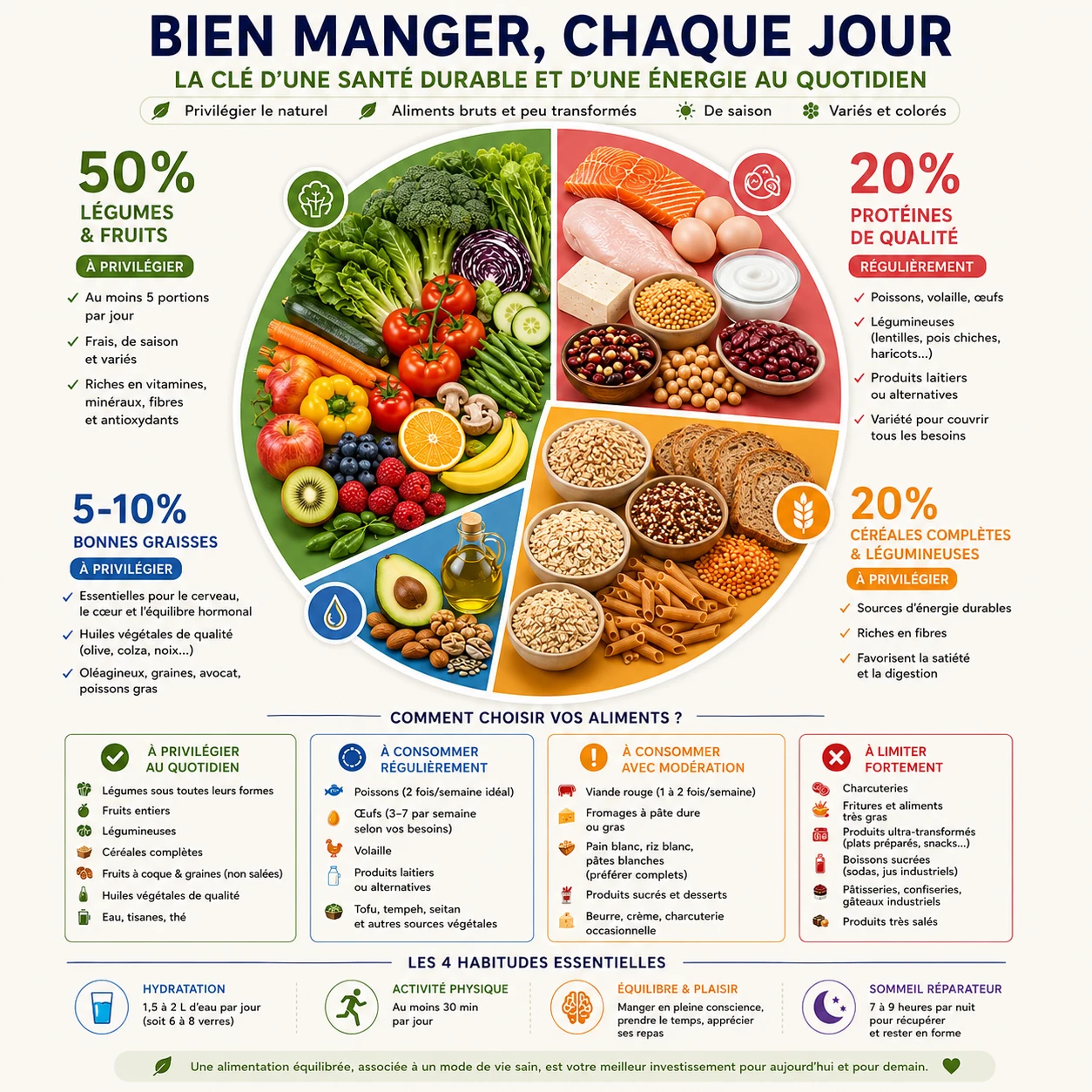
Through this diagram, the idea is to understand the different nutrients we need in our daily lives so that our body can function properly. To know in which foods we can find these different nutrients, and in what proportions they should be eaten.
From the pyramid to the plate
In 1992, a first nutrition campaign took place in the United States with the famous food pyramid diagram, to address the growing problem of obesity. Since then, this method has been heavily criticized and revisited. For our part, rather than a pyramid, we suggest the diagram of a food plate, which seems to us a representation closer to our habits.
The main families of nutrients
Overall, there are several families of nutrients:
- Vitamins (A, B, C, D, E, K)
- Proteins (amino acids)
- Carbohydrates (starch)
- Lipids (fatty acids)
And I would add (even though others could be added):
- Minerals
- Trace elements
- Fiber
Vegetables and fruit: fiber, vitamins and minerals
Vegetables and fruit are necessary because they are rich in fiber, minerals and vitamins.
Fiber is necessary for our intestines because it feeds and maintains the gut microbiota, made up of yeasts, bacteria, fungi, enzymes, etc. These bacteria are needed to transform our food so that it can be absorbed. Foods that are very rich in fiber include, for example, broccoli, spinach, cabbage, etc.
If we do not feed our digestive tract enough fiber, the consequence is intestinal dysbiosis, that is, an overrepresentation of certain families of bacteria, or an underrepresentation of other families, which leads to poor absorption of nutrients. It can also lead to intestinal hyperpermeability, which will then let pathogens through and lead to infections or inflammation.
Fruit and vegetables also provide vitamins, some of which are antioxidants. Conversely, deficiencies in certain vitamins can cause lowered immunity, dry eyes, fatigue, nervous disorders, irritability, cramps, anemia, sleep disorders, nausea, hair loss, bone fragility, etc.
Like nuts and seeds, which we will discuss a little later, they also provide minerals. Minerals are calcium, magnesium, phosphorus, sodium, potassium, etc. They are necessary for the bones, for muscle contraction including the heart, for fluid balance, nerve impulses, etc.
We could also mention foods such as artichoke and black radish, which support the liver and detoxify it, help with bile secretion, etc.
Proteins
Proteins are chains of amino acids, most of which are produced by our body, meaning it is able to metabolize them itself. There are nine essential amino acids that we must get from our diet, since the body does not make them.
Here we find red meats, white meats, eggs, fish, dairy products, but also legumes, that is, lentils, chickpeas, all kinds of beans, peas, soy, etc.
Legumes contain proteins, fiber and carbohydrates. Legumes are therefore very complete; at some meals they can replace a source of animal protein and a source of carbohydrates such as pasta, rice or potatoes. The drawback compared with proteins of animal origin is that they are less well absorbed by the digestive system (because of their more complex structure, fiber…), and they do not contain all the types of amino acids we need. It is therefore advisable to mix different flours / legumes, whether chickpeas or lentils, supplemented with corn for example, to get the different amino acids, if you follow a vegetarian diet.
Eggs are a very good source because they contain proteins, cholesterol (good cholesterol), as well as a number of minerals and vitamins.
There are also dairy products, which are also a source of protein, via casein and whey, but which are also a source of lactose, and therefore sugar. So you also need to be careful not to eat too much of them, since they still contain fat and sugar.
Proteins are necessary for our muscles, our tissues, skin, tendons, organs, for most enzymes, and therefore for all chemical and metabolic reactions, for the immune system, etc. Certain groups of proteins are found in the blood (albumin, globulin…), and they are necessary for transporting nutrients and waste.
Carbohydrates
Next comes the carbohydrate part. Here again we find legumes, and then the different types of grains. Carbohydrates are starch, and therefore more or less complex chains of sugar (glucose).
Legumes are found both on the protein side, since they provide protein along with iron (necessary for hemoglobin / red blood cells, to carry oxygen in the blood). But they are also found on the grain side, since they contain carbohydrates. The advantage of legumes over white rice and the like is that they have a much lower glycemic index. This is because their fiber content and more complex structure make the breakdown of carbohydrates take longer. Sugar therefore rises more slowly in the blood, which makes them an interesting food source for people with diabetes.
In this group we find pasta, potatoes, barley, rye, rice, bread, etc. Here it can be worthwhile to favor whole grains rather than white bread or white rice, because they contain more fiber and nutrients, and here too a lower glycemic index.
Lipids
We will finish with lipids, fats, one of the main sources of energy, along with carbohydrates, for the cells, at the level of the mitochondria. Mitochondria are small energy factories within cells that mainly use and oxidize lipids and carbohydrates to produce energy (ATP).
This group includes fatty acids, omega 3, but also omega 6 and omega 9. There is a blog article dedicated to fatty acids.
Here we find the different oils: olive oil, walnut oil, rapeseed oil, flaxseed oil, etc. We also find nuts and seeds (almonds, walnuts, hazelnuts, pistachios…); for our part, we recommend a handful of these nuts every morning. They contain natural minerals (potassium, magnesium…) and several trace elements (iron, zinc, copper, selenium, etc.).
Omega-3/6/9 are also important for the body, since they contribute to the cardiovascular system and to our brain via neuronal membranes; they are anti-inflammatory, and they contribute to hormonal balance, to the production of digestive juices, etc.
Over a one-week cycle
| Family | Frequency over the week |
|---|---|
| Fruit and / or vegetables | It is important to eat them almost daily. |
| Proteins | About 2 fish, 3 to 7 eggs, 2/3 legumes, 2 red meats, and 2/3 white meats. |
| Carbohydrates | Almost daily as well, alternating grains and legumes, and trying to include whole grains. |
| Lipids / fatty acids | Several times a week via small oily fish, oils, nuts and seeds, avocado, etc. |
Fatty foods in moderation:
- Red meat
- Cheeses
- Cream, butter
- Industrial products, sugary / processed products
- Cured meats
If you follow a vegetarian diet
- Make sure to vary your sources of legumes and grains to cover the different amino acids.
- Supplement with vitamin B12, which is entirely of animal origin.
- Check for any deficiency in iodine, which the thyroid needs to make the hormones T4 and T3, necessary for metabolism.
- Watch out for iron deficiencies. Plant iron combined with vitamin C (bell peppers, kiwi, citrus fruits…) significantly increases its absorption.
Watch out for absorption
- Caffeine, milk and also certain teas / theine can reduce the absorption of iron and certain minerals, so you need to space out intake.
- Other things such as activated charcoal or (green) clay can also trap certain elements or medications.
Polyphenols
Teas and coffees are very interesting for the polyphenols they provide, which are powerful antioxidants.
In the evening
For evening meals, we tend to recommend light meals in order to favor gentle digestion in preparation for sleep, and thus better recovery.
We therefore avoid:
- Dairy products (slightly acidic and heavier to digest)
- Gluten (wheat, rye, barley, spelt)
- Red meats
And in everyday life, how do you do it?
If you don’t want to rack your brains over cooking, know that frozen foods also offer very good products, and will have far more nutrients and vitamins than vegetables that have sat for several days on the market stall or in the fridge. Products such as spinach, green beans, cabbage and others are therefore good compromises when frozen. Canned foods too, for vegetables and legumes (chickpeas, beans, lentils…), checking that there is no added salt or sugar.
The gut, our second brain
Finally, we will end on this note, with several things worth knowing about the gut:
- It contains between 200 million and 500 million neurons; it is our 2nd brain.
- It contains as many bacteria as there are cells in the body (30 to 40 trillion).
- It is responsible for 90% of serotonin secretion, the happiness hormone.
- It contains 70% of our immune cells.