
Traditional Chinese Medicine
The emotion / organ connection
Traditional Chinese Medicine
Translated by AI from FrenchRead the French original
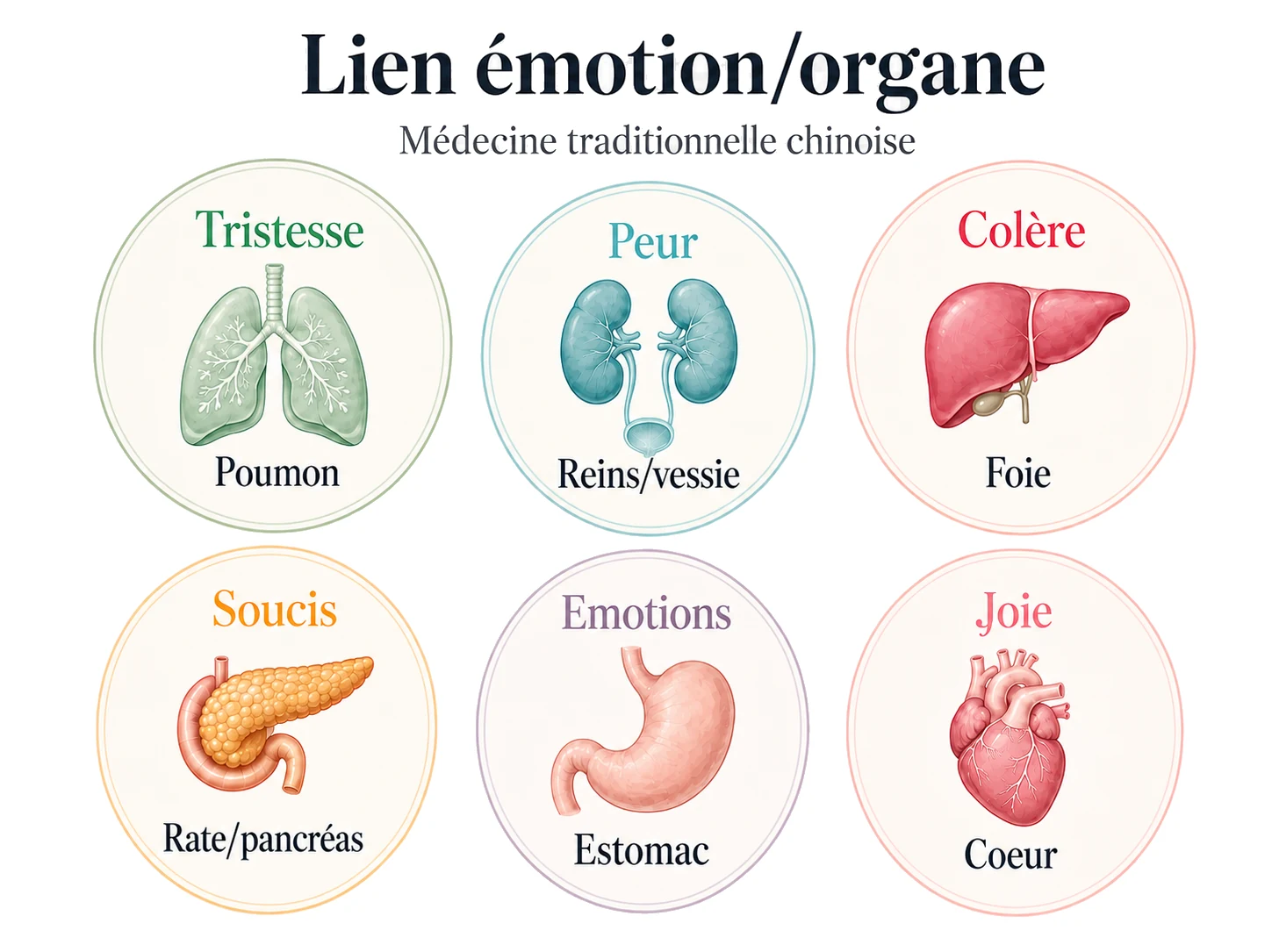
Emotions, internal causes of disease
In Traditional Chinese Medicine, as in other Asian medicines, the psycho-emotional reading holds an important place.
This is what is called the internal causes of disease, divided into 7 emotions: anger, joy, sadness, worry and overthinking, fear, and emotional shock.
Only the main ones are listed here, but other emotions such as envy, pride, shame, guilt, contempt, despair, indignation, humiliation, regret, remorse, self-loathing, resentment and smugness can also be vectors of disease.
The word emotion comes from the Latin emovere, which means “to let out”: this etymology speaks for itself.
How emotions show up in the body
By way of introduction, I will try to explain here how this manifests physically in the body, so that you understand that it can also be observed clinically.
When you undergo an electroencephalogram (EEG) to measure your brain activity, several brain rhythms are distinguished according to their frequencies (Hz):
- Delta (0.5–4 Hz): deep sleep, recovery
- Theta (4–8 Hz): drowsiness, daydreaming, deep meditation
- Alpha (8–13 Hz): relaxation, calm, meditation, eyes closed
- Beta (13–30 Hz): active wakefulness, concentration, thinking
- Gamma (30–80+ Hz): intense attention, learning, complex cognitive processing
So you emit different waves / frequencies depending on your brain activity.
It is the same with emotions: when you emit a more or less strong emotion, it too emits a wave, a vibration, which will come into resonance with one or more organs / tissues of your body. A bit like the resonant frequency of a system in physics (see the collapse of the Tacoma Bridge in the United States in 1940).
But that’s not all: when you experience an emotion, you activate your limbic system, which then triggers a chain reaction of actions and secretes a number of hormones! I talk about it here in a dedicated article.
The kidneys: fear, inner security
The kidneys are associated with fear, deep insecurity, self-depreciation, a sense of threat and personal power.
This sphere speaks of basic security: feeling able to cope, feeling supported by life, being able to move forward without constantly anticipating danger. The kidneys also refer to inner reserves, deep strength, the ability to endure and instinctive confidence in one’s own solidity.
When this sphere is out of balance, we find diffuse fears, underlying anxiety, difficulty feeling legitimate, fear of lack, fear of the future, a feeling of inner fragility or of loss of personal power.
In everyday life, this can show up as:
- fear of running out of money
- fear of abandonment / failure
- fear of illness
- fear of not being capable
- excessive need for control
- difficulty making decisions
- tendency to put oneself down
- feeling overwhelmed by responsibilities
- constant search for external security
- hypervigilance
- light or unrefreshing sleep
- waking up at night
- difficulty fully inhabiting one’s body
Associated disorders and diseases
| Emotional axis | Physical / psychological manifestations | Related disorders |
|---|---|---|
| Chronic fear | Hypervigilance, inner tension, anticipation of danger | Chronic anxiety, sleep disorders, nervous fatigue |
| Deep insecurity | Need for control, fear of lack, difficulty letting go | High blood pressure, lower back tension, exhaustion |
| Self-depreciation | Feeling of powerlessness, fear of acting, withdrawal | Chronic fatigue, low motivation, inhibition |
| Loss of personal power | Feeling of enduring one’s life, difficulty deciding | Functional urinary disorders, low back pain, pelvic tension |
| Night fear | Anxiety, nightmares, waking, startling | Night terrors, insomnia, nighttime restlessness |
The liver and gallbladder: anger, frustration
The liver and gallbladder are associated with anger, frustrations, resentment, a sense of injustice, the drive to act and the ability to decide.
This sphere speaks of our relationship to obstacles: how we react when a situation is blocked, when a boundary is crossed, when an injustice is felt or when a desire cannot unfold. Anger is an energy of movement here. It makes it possible to say no, to make decisions, to clarify and to restore direction.
When this sphere is out of balance, anger can become explosive or bottled up. It can be expressed as irritability, impatience, excessive reactions, muscle tension, but also as resignation, fatalism, discouragement or giving up.
In everyday life, this can show up as:
- getting angry quickly
- having a hard time tolerating slowness
- ruminating over an injustice
- feeling inner tension when a situation remains stuck
- having trouble accepting setbacks
- exploding and then feeling guilty
- holding on to silent anger
- feeling inwardly rebellious
- alternating between combativeness and giving up
- having difficulty deciding
- feeling tension in the jaw, neck, shoulders or temples
Associated disorders and diseases
| Emotional axis | Physical / psychological manifestations | Related disorders |
|---|---|---|
| Explosive anger | Rising tension, heat, agitation, impulsiveness | High blood pressure, palpitations, migraines |
| Chronic frustration | Inner blockage, impatience, tensing up | Neck tension, muscle pain, tension headaches |
| Resentment | Rumination, bitterness, inner rigidity | Functional digestive disorders, reflux, dyspepsia |
| Sense of injustice | Revolt, need for redress, bottled-up anger | Biliary disorders, digestive spasms, tension-related nausea |
| Decision paralysis | Difficulty deciding, loss of direction | Nervous fatigue, irritability, loss of motivation |
| Emotional compensation | Need to release or numb the tension | Drinking, food compulsions, liver overload, metabolic steatosis |
The lungs: sadness, closing off
The lungs are associated with sadness, grief, separation, closing off, confinement and the need for inner freedom.
This sphere speaks of the ability to receive and to let go. Breathing means welcoming what comes, then releasing what must leave. The lungs therefore represent our relationship to space, breath, freedom, connection and separation.
When this sphere is out of balance, we find difficulty expressing sadness, emotional closing off, a feeling of oppression, a sense of being trapped in a situation, a family, a role or a relationship. The person may also feel small, vulnerable, unprotected or deprived of space.
In everyday life, this can show up as:
- having a hard time crying
- crying very easily
- feeling oppressed
- lacking space
- feeling a tightness in the chest
- shallow breathing
- sighing often
- holding on to unexpressed grief
- cutting oneself off from others so as not to suffer anymore
- feeling trapped by obligations
- having a closed posture, hunched shoulders
- feeling persistent nostalgia or melancholy
The rib cage often expresses the way a person protects themselves from the world. A closed posture, a stiff chest or high breathing reflect protection, held-back sadness or difficulty fully allowing oneself to open up.
Associated disorders and diseases
| Emotional axis | Physical / psychological manifestations | Related disorders |
|---|---|---|
| Held-back sadness | Closed chest, shortness of breath, tight throat | Chest tightness, respiratory fatigue |
| Unprocessed grief | Melancholy, withdrawal, loss of drive | Depression, chronic fatigue, lowered immunity |
| Feeling of confinement | Need for air, feeling of constraint | Hyperventilation, anxious dyspnea, panic attacks |
| Emotional closing off | Closed shoulders, high breathing, emotional restraint | Worsened asthma, repeated bronchitis, nervous cough |
| Relational vulnerability | Fear of being touched, withdrawal, isolation | Sleep disorders, anxiety, emotional fatigue |
The spleen and pancreas: worry, anxiety, rumination, overthinking
The spleen and pancreas are associated with worry, concern, rumination, overanalysis, emotional digestion and self-care.
This sphere speaks of assimilation: assimilating food, but also emotions, information, responsibilities and events. It concerns the ability to receive, sort, integrate and then move on.
When this sphere is out of balance, the person thinks too much, analyzes too much, worries about everything, anticipates problems, goes round in circles on the same subjects and ends up mentally exhausted. They may give a lot to others, try hard to do well, but forget their own needs.
In everyday life, this can show up as:
- going over a conversation twenty times
- constantly wondering whether one did the right thing
- feeling responsible for others
- needing to understand everything before acting
- ruminating over a remark
- being afraid of forgetting something
- eating for reassurance
- seeking sugar or comfort
- having a hard time receiving
- cutting oneself off from one’s personal needs
- feeling drained after thinking too much
Associated disorders and diseases
| Emotional axis | Physical / psychological manifestations | Related disorders |
|---|---|---|
| Chronic worry | Repetitive thoughts, constant worry | Anxiety, mental fatigue, sleep disorders |
| Rumination | Mental loops, difficulty digesting events | Irritable bowel syndrome, bloating |
| Over-adaptation | Self-neglect, need to do well, overload | Chronic fatigue, exhaustion, digestive disorders |
| Need for comfort | Snacking, sugar, emotional eating | Weight gain, food compulsions, insulin resistance |
| Slow emotional digestion | Feeling of heaviness, difficulty moving on | Dyspepsia, constipation, functional diarrhea |
| Pancreatic imbalance | Fatigue after meals, sugar cravings, unstable energy | Reactive hypoglycemia, type 2 diabetes in predisposed individuals |
The stomach and diaphragm: assimilating the emotional flow
The stomach is associated with the reception of events, words, tensions, information and emotions. The diaphragm represents a gateway between the upper and lower body: between mind, heart, breathing and belly.
This sphere speaks of managing the emotional flow. It shows how a person receives what happens, how they assimilate experiences, how they let emotions descend into the body, and how they accept or refuse what comes their way.
When this area is out of balance, the person may have trouble “digesting” a situation. They hold back, control, clench, block, hold their breath or feel overwhelmed. The diaphragm closes when emotions no longer flow freely.
In everyday life, this can show up as:
- having a knot in the stomach
- feeling a pit in the stomach
- losing one’s appetite under stress
- eating to calm an emotion
- having a hard time swallowing a situation
- feeling nauseous before an important conversation
- holding back tears
- blocking one’s anger
- holding one’s breath in tense situations
- feeling pressure under the ribs
- having a hard time letting go
- feeling invaded by too much information or too many emotions
Associated disorders and diseases
| Emotional axis | Physical / psychological manifestations | Related disorders |
|---|---|---|
| Emotional overflow | Knotted stomach, saturation, overload | Functional dyspepsia, nausea, epigastric pain |
| Difficulty digesting a situation | Dwelling, blockage, abdominal tension | Gastroesophageal reflux, gastritis, digestive heaviness |
| Emotional control | Blocked breathing, tense diaphragm | Tightness, spasms, intercostal tension |
| Held-back emotions | Breath-holding, pit in the stomach, tensing up | Panic attacks, hyperventilation, somatized anxiety |
| Inner refusal | Difficulty accepting, closing off, resistance | Appetite disorders, nausea, digestive spasms |
| Relational overload | Feeling invaded, exposed belly | Bloating, irregular transit, abdominal pain |
The heart: joy, love and worthiness
The heart is associated with joy, zest for life, love, connection, worthiness, presence, emotional openness and the ability to move forward.
This sphere speaks of the intimate relationship with oneself, with others and with life. It shows the ability to love, to receive love, to feel gratitude, to rejoice, to forgive, to feel alive and to follow what gives meaning.
When this sphere is out of balance, the person may lose their drive, remain stuck in the past, no longer feel worthy, have a hard time receiving love or cut themselves off from deep joy. Conversely, excess can lead to agitation, excessive desires, impatience, constant excitement, a need for intensity or difficulty settling down.
In everyday life, this can show up as:
- no longer feeling like doing anything
- feeling cut off from joy
- living in nostalgia
- having a hard time receiving a compliment
- not feeling worthy of being loved
- protecting oneself from intimacy
- constantly seeking stimulation
- confusing excitement with joy
- feeling palpitations during strong emotions
- being impatient
- insomnia
- overexcitability
- a flood of words
- migraines
- having a hard time forgiving
- keeping an emotional wound open
Associated disorders and diseases
| Emotional axis | Physical / psychological manifestations | Related disorders |
|---|---|---|
| Loss of vital drive | Emotional fatigue, lack of interest, undigested past | Depression, chronic fatigue, loss of motivation |
| Heartache | Relational pain, closing of the heart | Chest tightness, palpitations, anxiety |
| Lack of worthiness | Difficulty receiving, self-sabotage | Anxiety disorders, lowered self-esteem |
| Emotional agitation | Excitement, impatience, nervousness | High blood pressure, tachycardia, rhythm disorders in predisposed individuals |
| Intense emotional stress | Emotional shock, breakup, loss, stupor | Takotsubo syndrome, anxiety attack, cardiac tightness |
| Relational closing off | Protection, fear of loving, isolation | Depression, emotional fatigue, sleep disorders |
Symbolic reading of the body areas
| Area | Symbolism | Possible imbalances | Related disorders |
|---|---|---|---|
| Head | Mind, intuition, higher vision Sense of the sacred, clarity | Mental overcontrol, confusion, overload, difficulty trusting | Headaches, migraines, concentration problems, mental overload |
| Neck | Bridge between head and heart Coherence | Rigidity, opposition, conflict between thought and feeling | Neck pain, neck tension, stiffness |
| Throat | Communication, expression, truth Self-assertion | Things left unsaid, fear of speaking, held-back speech | Tight throat, emotional loss of voice, upper neck tension |
| Shoulders | Burden, responsibility, support Pride, ability to carry | Carrying too much, having to be strong, pressure, guilt | Shoulder pain, tense trapezius muscles, back tension |
| Arms / hands | Action, contact, giving and receiving Freedom of action | Difficulty taking, giving, acting, asking or receiving | Arm tension, clenching, joint pain |
| Chest / lungs | Breath, space, openness to the world Inner freedom | Closing off, held-back sadness, excessive protection | Tightness, shortness of breath, nervous cough, hyperventilation |
| Heart | Intimate relationship, love, vulnerability Compassion, forgiveness, giving | Fear of loving, loss of drive, feeling of not being worthy | Palpitations, tightness, emotional anxiety |
| Diaphragm | Emotional passage, release Flexibility, acceptance | Control, breath-holding, emotional blockage | Spasms, reflux, blocked breathing |
| Belly | Exposure, digesting the world, personal worth Being supported, feeling worthwhile | Shame, relational insecurity, emotional overflow | Bloating, abdominal pain, digestive disorders |
| Lower back | Deep support, material and existential security Solidity | Fear of lack, overload, feeling unsupported | Low back pain, sciatica, pelvic tension |
| Hips | Choice, direction, taking action Openness | Difficulty deciding, fear of moving forward, resistance to change | Hip stiffness, pelvic pain, mobility blockages |
| Genitals / pelvis | Intimacy, permission, desire, deep identity Acceptance, strength | Shame, taboo, intimate closing off, difficulty allowing oneself | Pelvic tension, sexual disorders, pelvic pain |
| Legs | Moving forward, autonomy, embodiment Mastery of one’s life | Fear of moving forward, instability, dependence, loss of direction | Heavy legs, muscle tension, fatigue on exertion |
| Knees | Flexibility, humility, adaptation Suppleness | Resistance, defensive pride, difficulty bending without submitting | Knee pain, stiffness, joint inflammation |
| Feet | Rootedness, reality, presence Grounding | Disconnection, scattering, difficulty inhabiting one’s concrete life | Foot pain, instability, feeling of not being grounded |