
References: Epictetus, Seneca, Marcus Aurelius
Stoicism
Cultivating rightness and inner freedom
Translated by AI from FrenchRead the French original
Stoicism offers a way of learning to live with clarity in a world we do not fully control. It invites us to examine our judgments, to reason with our desires and to act with virtue, while accepting what lies beyond our will.
Inner freedom is built in the way we receive events and choose to respond to them.
1. Distinguishing what depends on us from what does not
Stoicism rests on a fundamental distinction:
- What depends on us: the assent we give to our thoughts, our intentions, our choices and the efforts we commit.
- What does not depend entirely on us: our health, other people’s reactions, our reputation, the weather, circumstances and the outcome of our actions, etc.
We can take care of our body, prepare a project or nurture a relationship, without guaranteeing how they will turn out.
The point is to focus our energy on our share of the action and to let go of the demand to control the outcome.
There is no use ruminating against the weather or against things we do not control: it changes nothing about the events and gives our ego the illusion that we can control the situation.
2. Accepting what is and letting go
Accepting means recognizing reality as it presents itself, even when we dislike it. Inwardly refusing that an event that has already happened took place adds a struggle to the initial difficulty.
This acceptance remains compatible with action: one can recognize an injustice, seek to correct it and accept that its outcome remains uncertain.
Welcoming the facts makes it possible to answer more clearly the question: “What can I do, now, with this situation?”
This is linked to the first principle: indeed, very often we have no choice but to accept the situation, the event as it happens. Typically, if someone accidentally hits my car in a parking lot and damages the whole front, I can grumble and yell at the person responsible all I want, the bodywork won’t return to its original condition for all that.
This does not mean we should be passive and do nothing; we must of course act, but free of any emotion, accepting the situation as it is. This will keep us from ruminating, from replaying the scenario telling myself: what if I hadn’t parked here, what if I had left sooner, etc.
3. Stepping out of automatic judgment
We often add an immediate interpretation to the facts: “This is unbearable,” “He is disrespecting me,” “This failure proves I am worthless.”
The Stoic work consists in distinguishing:
- The fact: what actually happened.
- The judgment: the meaning or value we attribute to it.
- The response: the attitude we choose to adopt.
For example, “This person didn’t reply” is an observation; “She despises me” is an interpretation.
Stepping out of judgment means suspending hasty conclusions and sweeping condemnations. It is about keeping one’s discernment while recognizing that one’s first reading may be incomplete.
By changing the way we look at a situation, we change the emotion. It is our judgments that need correcting, not external events.
Our emotions are often the reflection of what we cannot manage to accept in reality.
4. Mastering emotions / passions and impulses
The Stoics emphasize the link between our judgments and our emotions. When we interpret a situation as a humiliation, a catastrophe or an absolutely indispensable good, we feed anger, fear or excessive desire.
A first reaction may nevertheless arise spontaneously: a start, tension, sadness or a flash of anger. Self-mastery is worked on in what we do next with it.
The practice consists in:
- recognizing the emotion without condemning oneself;
- examining the judgment that accompanies it;
- leaving a space before speaking or acting;
- choosing a proportionate and considered response.
Inner stability makes it possible to feel without letting the emotion alone decide our conduct.
Emotions become a cause of illness when we no longer control them but they control us.
These two statements evoke losing one’s temper, being on the reactive side of an event, letting ourselves be overwhelmed by our emotion. In this state, we are no longer able to take a pause to assess our opinion, or to be self-critical and reconsider if need be. It is at that moment that we may make gestures or say words we will regret.
Generally speaking, it is easier to let the emotional side express and externalize itself, because this is less painful for our ego than admitting we were wrong.
Indeed, anger or other emotions are sometimes a refuge, an escape, so as not to face the truth and admit we were wrong. Because from then on, it will make us feel shame and guilt, which are hard to overcome, so we prefer anger and resentment to escape them.
However, rather unpleasant emotions, such as anger, resentment and pride, are not to be banished, quite the contrary: every emotion has its legitimacy and its usefulness.
Anger, for example, can also serve to set one’s limits, to restore justice for oneself. Anger is sometimes there to get a message across, and rather than flying off the handle it is possible to listen to it, ground oneself, and correct / restore what is causing it, in terms of needs, limits, values… So it should not be repressed or masked out of shame, but recognized and listened to so that it can reveal its message. If someone has disrespected or offended you, then anger is there to restore justice, one’s self-image.
5. Reasoning with desires
A desire becomes a source of dependence when we make its satisfaction an indispensable condition for our happiness: being admired, always succeeding, owning more or gaining someone’s approval. We can also become slaves to our desires, like someone who cannot fully control their sexual urges, or someone in the grip of an addiction.
Reasoning with one’s desires consists in asking oneself:
- Does this desire answer a real need or an endless pursuit?
- Does its satisfaction depend on me?
- Is what I am seeking worth the price I place on it?
- Can I prefer it without making it an absolute necessity?
One can wish for health, comfort or success, while accepting that they are not guaranteed.
To add to the part on sexual desires, Freud set out three types of desire in life:
- The desire of the senses: satisfied through carnal pleasure.
- The desire for knowledge: the quest for knowledge, the wish to learn, to study and to understand the world.
- The desire for power: being an authority figure, through the political system, law enforcement, hierarchy in general.
He thus called sublimation an energy of sexual origin, redirected and used toward another goal, such as a scientific discipline.
6. Seeking balance and the right measure
Stoicism invites us to avoid excess, to adjust our reactions and to maintain coherence between reason, desires and actions.
This search for the right measure can be compared to the importance given to balance in traditional Chinese medicine, even though their foundations are different.
Regarding external circumstances, it is useful to distinguish what is pleasant or unpleasant from what is morally good or bad. A pleasant experience is not necessarily beneficial; a painful experience can be gone through with courage and clarity.
For the Stoics, this distinction does not abolish good and evil: virtue is the moral good, and vice the moral evil. Illness or failure do not make a person bad, any more than wealth or success make them just.
Balance consists in welcoming experiences without letting them determine all of our worth or all of our conduct.
One philosopher who advocated moderation and frugality is Epicurus. So being an Epicurean does not mean enjoying without measure, but on the contrary knowing how to moderate one’s pleasures so as not to fall into excess. Indeed, 1 or 2 glasses of alcohol are pleasant, whereas 10 glasses will have consequences the next day, as well as in the long term.
7. Cultivating humility
Humility consists in recognizing the limits of our knowledge, our judgment and our power.
We do not know all the causes of an event, nor everything another person is going through. We can be wrong, change our minds and learn.
This attitude invites us to:
- listen before concluding;
- welcome useful criticism;
- acknowledge one’s mistakes;
- give up the need to always be right;
- practice one’s principles without seeking to appear superior.
Humility makes it possible to progress without believing one has arrived.
Here we could mention the Dunning-Kruger effect; this effect explains that the less we know about a field, the higher our self-assurance / confidence. Indeed, someone who has studied all the contours and issues of a field will tend to ask more questions and express more reservations when asked for an opinion, because they master all its subtleties. Conversely, someone who has a simplified view of a discipline will have the illusion of mastering it and will take shortcuts.
This is also what we see in the graph: beginners can quickly see their confidence in a field grow at the start of their learning, before coming up against everything behind the scenes (the exceptions to the rule, the technical details, the adaptations, the gap between theory and practice…).
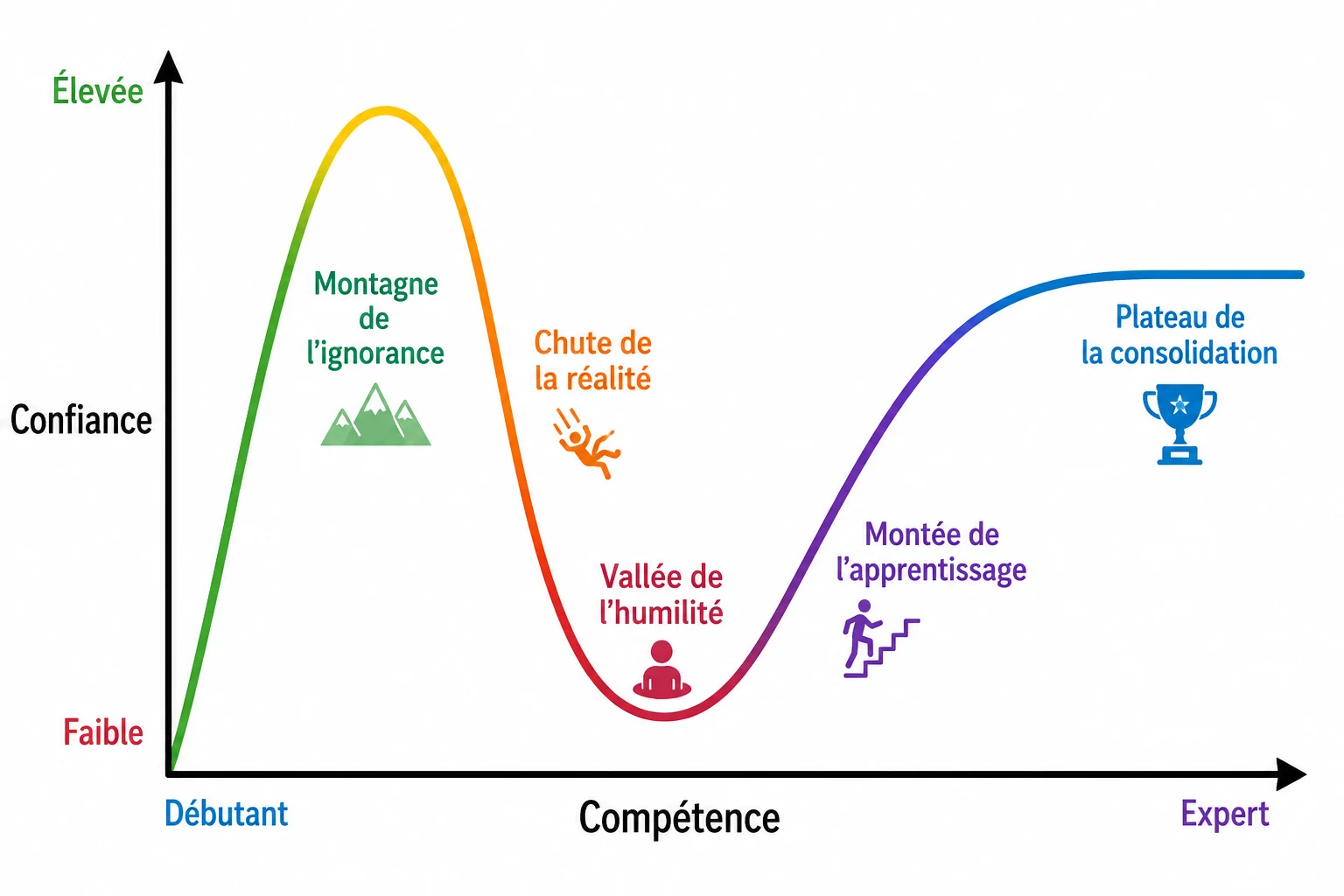
Sometimes we confuse knowledge and identity, as is the case for example when political or religious subjects, etc., come up. An identity is not inseparable from anything; we are the ones who shape it. But sometimes questioning a belief amounts to questioning a part of our identity, and therefore of our life. It is then so destabilizing that we refuse to do it.
Seek to know rather than to believe, in order to be closer to the truth.
Sometimes certain beliefs have been rooted for generations, through our culture, customs, practices, upbringing, etc. These beliefs have then become habits to such an extent that we no longer pay attention to them, or they have become dogmatic. It is a bit like: “why would we change, we’ve always done it this way.”
To conclude on humility, we all make mistakes, and acknowledging them is a mark of respect, wisdom, humility and consideration for others. It does not make you ignorant or weak; it shows clarity and courage.
8. Cultivating virtue
For the Stoics, a fulfilled life is built through the quality of our choices. Four virtues guide this practice:
- Wisdom: discerning the facts, examining one’s judgments and choosing with clarity.
- Justice: respecting others, acting fairly and contributing to the common good.
- Courage: facing difficulties and doing what is right despite fear.
- Temperance: moderating one’s desires, mastering one’s impulses and seeking the right measure.
These virtues reinforce one another. Courage benefits from being guided by wisdom; self-mastery takes on its meaning when it serves a just action.
A doctrine along these lines is utilitarianism, which holds that an action is judged morally good if it serves the general interest and maximizes the happiness of the greatest number.
9. Living in the present moment
The past can teach us and the future deserves to be prepared for. But our action always takes place in the present.
Stoicism invites us to bring our attention back to what we are doing now, rather than remaining absorbed by regrets or anticipated scenarios.
This means:
- paying attention to the task at hand;
- being available in one’s relationships;
- carrying out the useful action within one’s reach;
- coming back to reality when the mind gets lost in suppositions.
Focusing on the present means giving full quality to the moment in which we can actually act.
We are sometimes accomplices in our own unhappiness, since we project ourselves into the future or into the past. For example, I may be afraid of having my motorcycle stolen, or that my partner is cheating on me, etc. I then keep perpetuating an emotion of pain experienced in the past, or else out of fear that something will happen. So I am either in the past or in the future, but not in the present moment.
10. Accepting impermanence and change
Everything transforms: the body, relationships, situations, possessions and emotional states. The Stoics invite us to integrate this mobility of the world rather than demanding that things stay the same.
Recognizing the passing nature of things helps to:
- appreciate what is present;
- go through difficult periods without believing them to be eternal;
- go along with life’s changes;
- love without considering beings as possessions;
- accept old age and death as natural realities.
Awareness of change invites us to fully live what is given to us, without demanding to keep it forever. It is therefore important not to become too strongly attached to material things, or not to make our inner joy depend on external things we do not control. See the article: psychological & emotional dependence.
Nothing is constant; only change is permanent.
Impermanence is the very characteristic of all circumstances.